
How Risk Scores Transform GRC for Better Risk Management
Dhiren M | 5 Dec 2025 | 8 Dec 2025
In today’s dynamic digital and regulatory environment, organisations face an increasing number of threats—cyberattacks, operational failures, vendor risks, compliance violations, and data breaches. Managing these risks effectively requires a structured and measurable approach. This is where risk scores become the backbone of modern GRC (Governance, Risk, and Compliance) programs.
Risk scores allow organisations to transform subjective risk evaluations into objective, comparable, and actionable metrics. When implemented correctly, risk scoring empowers teams to prioritise threats, allocate resources intelligently, and strengthen the overall risk management framework.
Understanding Risk Scores in GRC Risk Management
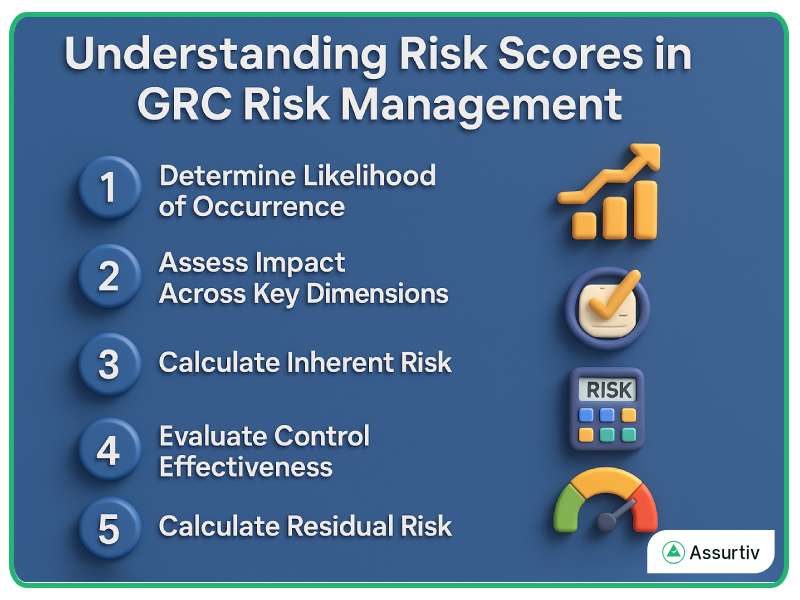 Risk scores are numerical values assigned to risks based on their likelihood, impact, and sometimes additional factors like velocity or exposure. These scores help risk owners evaluate the severity of a threat using consistent criteria.
Within a mature GRC risk scoring model, risk scores drive decision-making, determine treatment plans, and ensure that business leaders have real-time visibility into organizational risk posture.
Why Risk Scores Matter
- They standardise risk evaluation across departments
- They avoid subjective judgement errors
- They help identify high-priority threats
- They streamline audit and compliance reporting
- They support data-driven risk mitigation
How Risk Scores Are Calculated — Core Methodology
Calculating risk scores requires a well-defined risk assessment methodology. Most organisations follow a structured process that includes identifying the risk, analysing contributing factors, scoring them, and mapping the results on a risk heatmap.
Below is the typical scoring foundation used in GRC frameworks.
Step 1 — Determine Likelihood of Occurrence
Likelihood reflects the probability of a risk event happening.
A common scale is 1–5, where:
- 1 = Rare
- 3 = Possible
- 5 = Almost Certain
This scale ensures each risk is evaluated using a consistent and quantifiable measure.
Step 2 — Assess Impact Across Key Dimensions
Impact considers consequences across multiple domains such as:
- Financial loss
- Legal and compliance violations
- Reputational damage
- Operational disruption
- Customer trust and data sensitivity
A similar 1–5 impact score helps standardise measurement.
Step 3 — Calculate Inherent Risk
Inherent risk represents the natural level of risk before introducing any controls.
Inherent Risk = Likelihood × Impact
This formula provides the baseline threat level and highlights risks that require immediate attention.
Step 4 — Evaluate Control Effectiveness
Controls reduce the probability or impact of a risk.
Examples include:
- Firewalls
- Access controls
- Vendor audits
- Compliance policies
- Monitoring systems
Control effectiveness is typically expressed as a percentage (e.g., 60%, 75%, 90%).
Step 5 — Calculate Residual Risk
Residual risk shows the remaining risk after controls are applied.
Residual Risk = Inherent Risk × (1 – Control Effectiveness)
This step is crucial because it highlights whether risk treatments are working or if additional measures are required.
Advanced Factors Influencing GRC Risk Scores
Modern GRC platforms use more than just likelihood and impact. To improve precision and meet evolving regulatory expectations, many organisations include additional dimensions such as:
- Velocity: How quickly a risk can materialise once triggered.
- Detectability: How easily the organisation can spot the risk before it causes harm.
- Exposure Level: How many systems, customers, or assets are affected if the risk occurs.
When these variables are added to scoring formulas, the result is a more realistic and actionable risk score.
Using Risk Scores to Strengthen Enterprise Risk Management
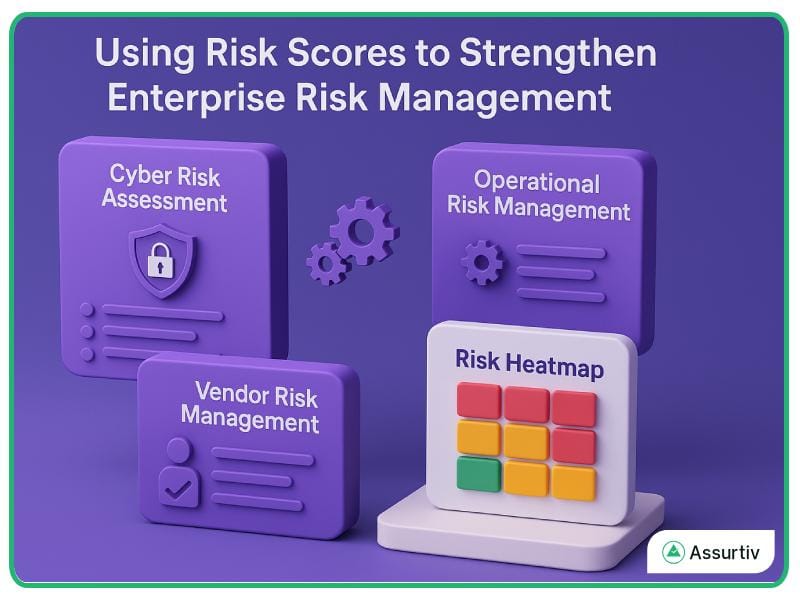 Risk scores play a crucial role across several GRC use cases. Integrating them within an enterprise risk management platform ensures organisation-wide visibility, accountability, and decision-making support.
Cyber Risk Assessment
Cybersecurity threats such as phishing, ransomware, and credential compromise require continuous monitoring.
Using risk scores helps security leaders:
- Evaluate vulnerabilities
- Prioritise security patches
- Assess exposure from cloud environments
- Reduce the chances of data breaches
Operational Risk Management
Operational failures—process breakdowns, system outages, human errors—can significantly impact business continuity.
Risk scores enable teams to:
- Measure process-level weaknesses
- Validate internal controls
- Implement preventive corrective actions
Vendor Risk Management
Third-party vendors introduce supply-chain risks, data exposure, and compliance challenges.
By applying risk scoring:
- Vendors can be categorised as low, medium, or high risk
- Risk-based audits can be prioritised
- Contracts can be aligned with risk tolerance
Risk heatmaps convert numeric risk scores into intuitive colour-coded visuals.
A heatmap quickly shows:
- Which risks are in the red (high severity)
- Which risks require immediate mitigation
- Which risks can be tolerated or accepted
Leadership teams rely heavily on heatmaps for executive reporting, board presentations, and compliance reviews.
Implementing Risk Scores in a GRC Platform
For organisations seeking scalable, real-time risk visibility, implementing risk scoring within a GRC system is essential.
Key Benefits of GRC-Driven Risk Scoring
- Automated scoring reduces manual errors
- AI-assisted insights improve prediction accuracy
- Workflow automation streamlines risk treatment
- Centralised dashboards support compliance management
- Audit-ready reporting saves time and resources
A robust GRC tool ensures consistency across business units while allowing custom scoring models for cybersecurity, compliance, vendor, and operational risks.
Common Challenges and Best Practices in Risk Scoring
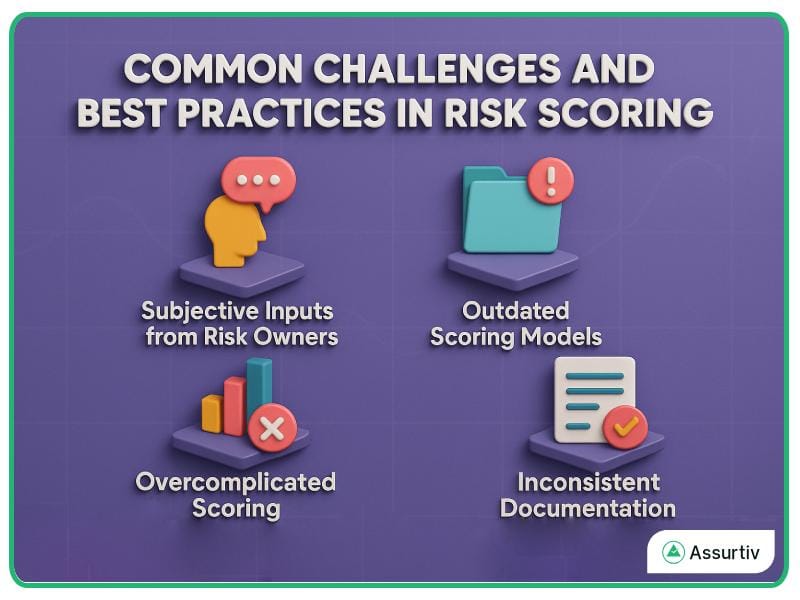
Even with defined models, organisations struggle with inaccurate or inconsistent scoring. Here’s how to overcome the most common challenges.
Subjective Inputs from Risk Owners
Solution: Train teams, define scoring criteria, and use automated suggestions from GRC tools.
Outdated Scoring Models
Solution: Update scoring methodologies annually based on new threats and business requirements.
Overcomplicated Scoring
Solution: Start simple (likelihood × impact) and gradually add factors like velocity or detectability.
Inconsistent Documentation
Solution: Maintain centralised records with clear evidence, version control, and audit logs.
Why Effective Risk Scores Drive Better Risk Management
At its core, risk scoring brings predictability, clarity, and automation to risk management. With well-implemented risk scores, organisations can:
- Prioritise mission-critical risks
- Align mitigation strategies with business goals
- Avoid compliance penalties
- Reduce costs linked to cyber incidents
- Improve audit readiness
- Strengthen their overall GRC maturity
In a world where risks evolve faster than ever, organisations that rely on structured and accurate risk scores are far better equipped to protect their operations, brand, and regulatory standing.
How Assurtiv Helps Organisations with Accurate Risk Scores
In a rapidly evolving threat landscape, organisations need more than manual spreadsheets or subjective judgment to manage their risks. Assurtiv GRC brings a modern, automated, and intelligent approach to risk management—powered by precise and dynamic risk scores that help teams make faster and more confident decisions.
Assurtiv GRC is designed to eliminate complexity, increase accuracy, and streamline compliance operations for startups, mid-size companies, and enterprises. Here’s how it accelerates risk maturity:
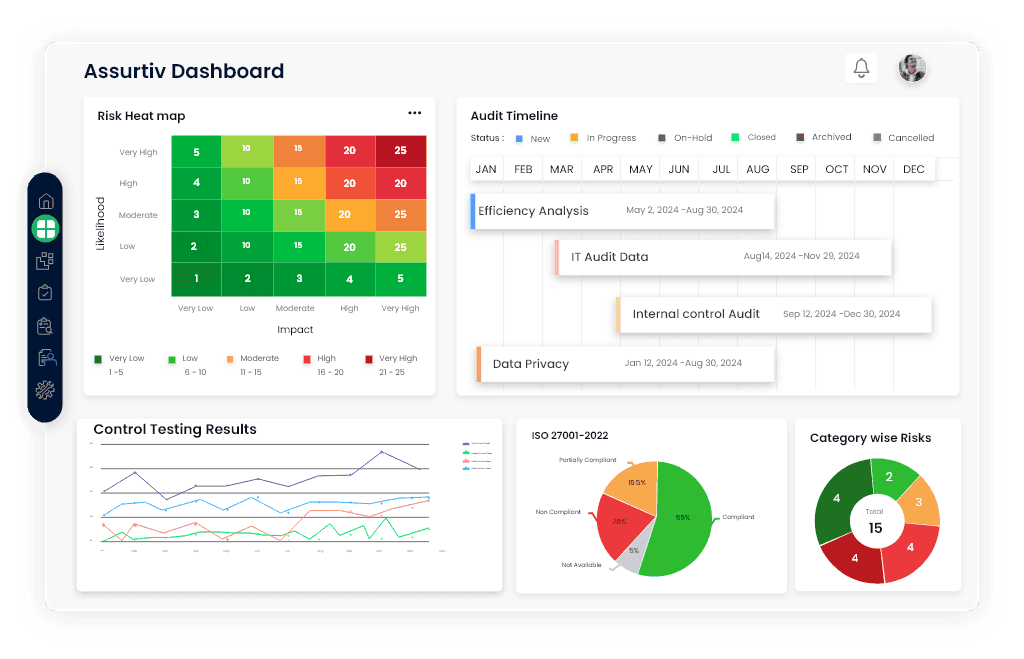
Automated Risk Scoring for Consistent and Reliable Results
Assurtiv GRC eliminates inconsistent manual scoring by automating the entire evaluation workflow.
The platform calculates:
- Inherent risk
- Residual risk
- Likelihood & impact
- Control effectiveness
This ensures every risk is rated accurately and uniformly across all departments.
Real-Time Dashboards & Heatmaps for Quick Decision-Making
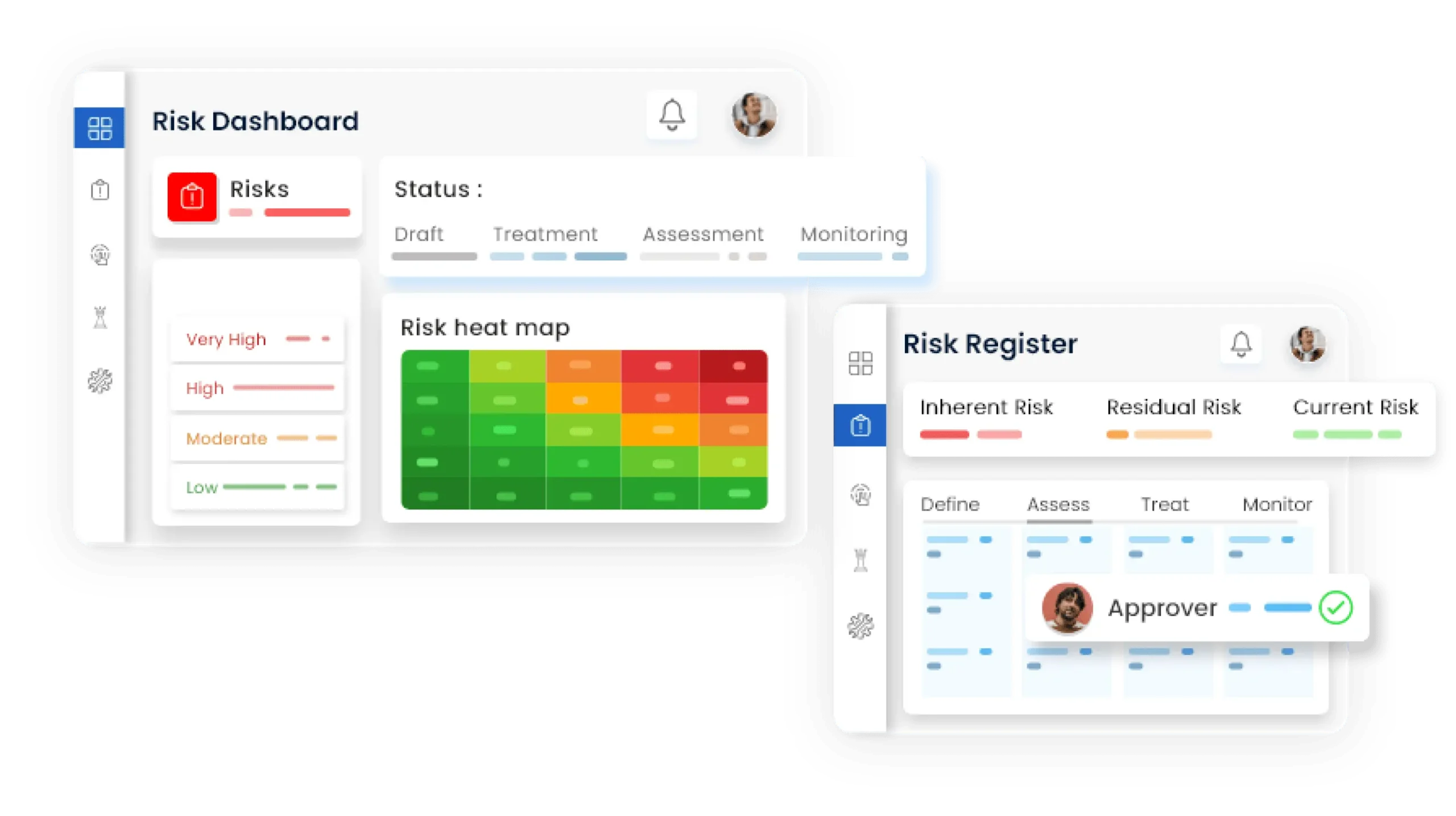
Assurtiv GRC converts risk scores into visual, easy-to-understand insights.
Teams can instantly see:
- High-risk items requiring immediate escalation
- Medium risks needing monitoring
- Low risks that can be accepted or reviewed later
Real-time risk heatmaps help leadership prioritise resources and act on critical threats without delays.
Integrated Controls Mapping to Strengthen Risk Treatment
With Assurtiv, every risk score automatically connects to:
- Relevant controls
- Compliance requirements
- Policies
- Audit evidence
This ensures that treatment plans are not just documented—but fully actionable and monitored.
Risk Workflows That Reduce Operational Burden
Assurtiv GRC simplifies complex risk processes with automated workflows for:
- Risk identification
- Assessment
- Approval
- Treatment tracking
- Periodic reviews
This helps organisations maintain a proactive risk posture instead of reacting after incidents occur.
AI-Assisted Insights for Better Predictive Risk Management
Assurtiv uses smart insights to analyse patterns, detect emerging risks, and suggest improvements.
This makes the risk scoring model predictive, not just diagnostic—giving risk teams an early advantage over threats.
Compliance-Ready Reporting in Minutes
Whether you need risk reports for:
- SOC 2
- GDPR
- Vendor assessments
- Board meetings
Assurtiv GRC generates audit-ready documentation based on your real risk scores—saving hours of manual effort.
A Unified Workspace for All Risks Across the Organisation
Assurtiv brings IT, cybersecurity, operational risk, and vendor risk into one unified platform.
This reduces silos and ensures every team speaks the same “risk language,” powered by a standardised and credible scoring system.
Conclusion
Implementing effective risk scores is no longer optional—it is essential for modern GRC risk management. A well-defined scoring model helps organisations identify threats early, allocate resources wisely, and maintain compliance in an increasingly complex regulatory environment.
But achieving this level of maturity isn’t easy with manual spreadsheets, scattered data, or inconsistent scoring methods. Organisations need a modern, automated, and intelligent solution—one that converts risk assessments into real-time, actionable insights.
This is exactly what Assurtiv GRC delivers.
With automated risk scoring, dynamic heatmaps, integrated controls, AI-assisted insights, and audit-ready reporting, Assurtiv enables companies to move from reactive to proactive risk management. Whether you’re a startup preparing for ISO 27001, a growing business ensuring DPDP Act compliance, or an enterprise strengthening vendor and operational risk processes, Assurtiv gives you the clarity, confidence, and control to manage risks effectively.
If your organisation wants to streamline risk processes, reduce manual effort, and make smarter risk decisions—Assurtiv, AI powered GRC tool built for you.
Start transforming your risk management today.