

DPDP Act 2023: Complete Compliance Guide for Businesses in India
assurtiv | 2 Jan 2025 | 14 Mar 2026
India has entered a new era of data governance with the introduction of the Digital Personal Data Protection Act (DPDPA) 2023. As organizations increasingly rely on digital data, protecting personal information has become a regulatory priority. The DPDP Act establishes a comprehensive framework that defines how organizations collect, process, store, and safeguard personal data of individuals.
For businesses operating in India, understanding the DPDP Act is no longer optional. Compliance with this law is essential to avoid significant financial penalties, reputational damage, and regulatory scrutiny.
Here, you will get a complete overview of the DPDP Act, including its objectives, scope, key stakeholders, compliance requirements, and practical steps organizations can take to align with the regulation.
What is the DPDP Act?
The Digital Personal Data Protection Act (DPDPA) 2023 is India’s primary legislation designed to regulate the processing of digital personal data. The law aims to balance two critical aspects:
Protecting the privacy rights of individuals
Allowing organizations to process data for legitimate purposes
The DPDP Act establishes rules for how organizations must collect, process, store, and manage personal data in digital form.
Key Goals of the DPDP Act
The regulation aims to:
- Strengthen individual data privacy rights
- Introduce accountability for organizations handling personal data
- Create a transparent framework for data processing practices
- Promote responsible data governance in India’s digital economy
As digital transformation accelerates across industries, the DPDP Act serves as a foundational law for privacy protection in India.
Why the DPDP Act Matters for Businesses
Organizations today handle vast amounts of personal data through digital platforms, applications, and cloud services. Without proper governance, this data can be vulnerable to misuse, breaches, or unauthorized access.
The DPDP Act introduces a legal framework that requires organizations to implement responsible data management practices.
Key reasons businesses must pay attention to the DPDP Act:
- Compliance is mandatory for organizations processing personal data of individuals in India
- Non-compliance can lead to significant financial penalties
- Businesses must demonstrate transparent data processing practices
- Organizations must implement data protection governance structures
Companies that proactively align with the DPDP Act not only reduce regulatory risk but also build customer trust and credibility.
Scope of the DPDP Act
The DPDP Act applies to the processing of digital personal data in several contexts.
The law applies when:
- Personal data is collected in digital form
- Data is digitized after being collected offline
- Processing activities relate to individuals located in India
The regulation also has extraterritorial applicability, meaning it may apply to organizations located outside India if they process data related to individuals within the country.
Entities affected by the DPDP Act include:
- Technology companies
- Financial institutions
- Healthcare providers
- E-commerce platforms
- SaaS providers
- Enterprises processing employee data
- Organizations offering digital services
Any organization that processes digital personal data of individuals in India must comply with the DPDP Act.
Key Stakeholders Under the DPDP Act
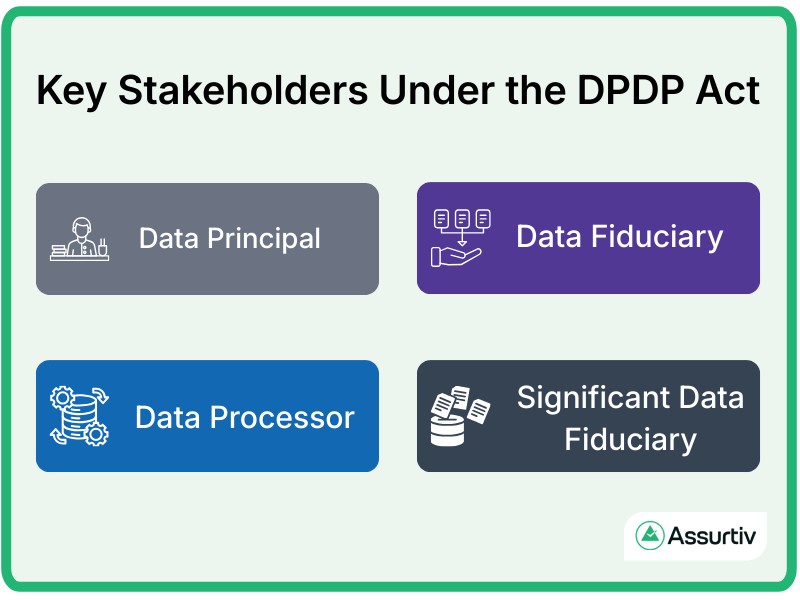
The DPDP Act introduces specific roles that define responsibilities in data processing activities.
Data Principal
A Data Principal is the individual to whom the personal data relates.
The DPDP Act grants individuals several rights regarding how their personal data is handled.
Data Fiduciary
A Data Fiduciary refers to the organization or entity that determines the purpose and means of processing personal data.
Examples include:
- Companies collecting customer information
- Employers processing employee data
- Online platforms managing user data
Data Fiduciaries are responsible for ensuring compliance with the DPDP Act requirements.
Data Processor
A Data Processor is an entity that processes personal data on behalf of a Data Fiduciary.
Examples include:
- Cloud service providers
- Data analytics vendors
- Third-party service providers
Data processors must operate according to the instructions of the Data Fiduciary.
Significant Data Fiduciary
Certain organizations may be classified as Significant Data Fiduciaries based on factors such as:
- Volume of personal data processed
- Sensitivity of data
- Potential impact on national interests
These entities must comply with additional regulatory obligations.
Key Principles of the DPDP Act
The DPDP Act establishes several principles that organizations must follow when processing personal data.
Purpose Limitation: Organizations must collect personal data only for specific and legitimate purposes.
Data Minimization: Only the minimum amount of personal data necessary should be collected and processed.
Consent-Based Processing: Organizations must obtain clear and informed consent from individuals before processing their personal data.
Accuracy of Data: Organizations must ensure that personal data is accurate and updated when necessary.
Storage Limitation: Personal data should be retained only for the duration required to fulfill the intended purpose.
Security Safeguards: Organizations must implement appropriate security measures to prevent data breaches or unauthorized access.
Rights of Individuals Under the DPDP Act
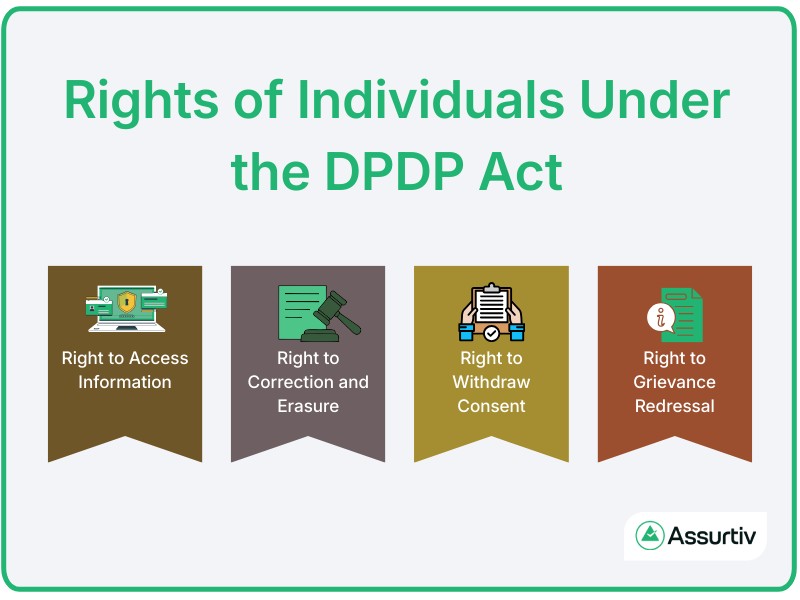
The DPDP Act empowers individuals with specific rights regarding their personal data.
Right to Access Information: Individuals can request details about how their personal data is being processed.
Right to Correction and Erasure: Individuals can request correction of inaccurate data or deletion of personal data when it is no longer required.
Right to Withdraw Consent: Individuals have the right to withdraw consent for processing their personal data at any time.
Right to Grievance Redressal: Individuals can raise complaints regarding misuse or improper handling of their personal data.
Compliance Requirements Under the DPDP Act: Organizations must implement several measures to ensure compliance with the DPDP Act.
Data Protection Governance: Businesses should establish policies that define how personal data is collected, processed, and protected.
Consent Management: Organizations must implement mechanisms to capture and manage user consent effectively.
Data Security Measures: Businesses should adopt technical and organizational safeguards such as:
- Encryption
- Access control mechanisms
- Secure storage systems
- Incident monitoring tools
Data Breach Management: Organizations must establish procedures to detect, report, and respond to data breaches.
Vendor Risk Management: Organizations must ensure that third-party vendors processing personal data comply with the DPDP Act.
Penalties for Non-Compliance
The DPDP Act introduces strict financial penalties for violations.
Depending on the severity of the violation, organizations may face significant penalties imposed by the Data Protection Board of India.
Violations may include:
- Failure to implement reasonable security safeguards
- Non-compliance with consent requirements
- Failure to report data breaches
- Processing personal data without lawful purpose
These penalties emphasize the importance of implementing robust compliance programs.
Practical Steps to Achieve DPDPA Compliance
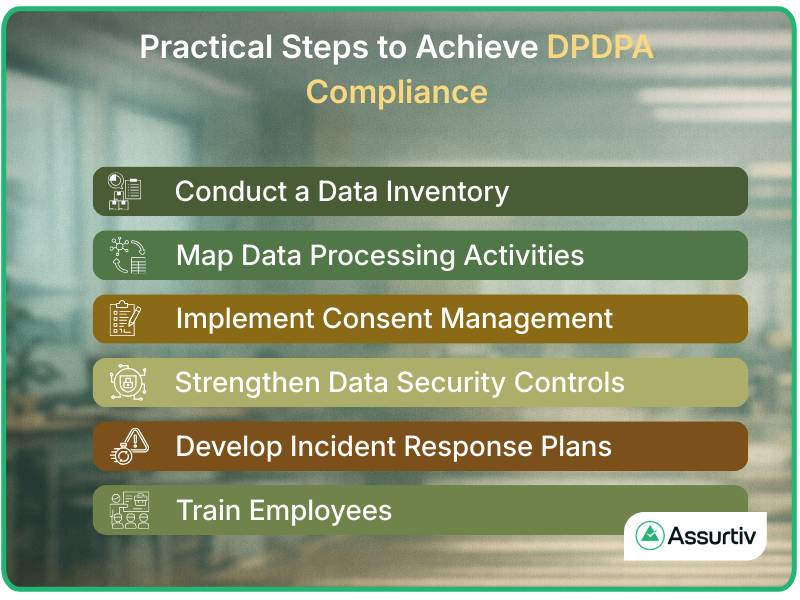 Organizations should adopt a structured approach to prepare for DPDPA compliance.
Step 1: Conduct a Data Inventory
Identify and document all personal data processed across systems.
Step 2: Map Data Processing Activities
Understand how personal data flows across the organization and third-party vendors.
Step 3: Implement Consent Management
Develop systems that enable transparent consent collection and withdrawal.
Step 4: Strengthen Data Security Controls
Implement technical and administrative safeguards to protect personal data.
Step 5: Develop Incident Response Plans
Prepare procedures to handle potential data breaches efficiently.
Step 6: Train Employees
Provide training programs to ensure employees understand data protection responsibilities.
How Governance, Risk, and Compliance (GRC) Platforms Support DPDP Compliance
Managing DPDP Act compliance manually can be complex, especially for large organizations that process significant volumes of data.
Modern GRC platforms help organizations automate compliance management by providing capabilities such as:
- Policy management
- Risk assessment
- Compliance monitoring
- Audit readiness
- Incident management
- Vendor risk management
By implementing structured compliance frameworks and automation tools, organizations can reduce regulatory risk while improving operational efficiency.
Building a Sustainable Data Protection Strategy
Compliance with the DPDPA should not be treated as a one-time activity. Instead, organizations should develop a long-term data governance strategy.
Key elements of a sustainable approach include:
- Establishing clear privacy policies
- Integrating data protection into business processes
- Regularly reviewing compliance frameworks
- Conducting periodic audits
- Implementing continuous monitoring mechanisms
Organizations that adopt a proactive strategy can transform compliance into a competitive advantage in the digital economy.
Conclusion
The DPDP Act 2023 represents a significant milestone in India’s data protection landscape. As organizations continue to rely on digital technologies, responsible management of personal data has become essential.
Businesses must take proactive steps to understand the requirements of the DPDP Act, implement governance frameworks, and establish strong security safeguards.
By adopting structured compliance practices, organizations can not only meet regulatory expectations but also build trust with customers, partners, and stakeholders.
Preparing for the DPDP Act today positions organizations for a more secure, transparent, and compliant digital future.
Frequently Asked Questions (FAQs)
What is the DPDP Act?
The Digital Personal Data Protection Act (DPDP Act) 2023 is India’s primary legislation that governs the processing of digital personal data and aims to protect the privacy rights of individuals.
Who must comply with the DPDP Act?
Any organization that processes digital personal data of individuals in India, including domestic and foreign entities offering services in India, must comply with the DPDP Act.
What are the key roles defined under the DPDP Act?
The DPDP Act defines several roles, including:
- Data Principal
- Data Fiduciary
- Data Processor
- Significant Data Fiduciary
Each role has specific responsibilities regarding data protection and processing.
What rights do individuals have under the DPDP Act?
Individuals have rights such as:
- Access to their personal data
- Correction or erasure of personal data
- Withdrawal of consent
- Grievance redressal mechanisms
What are the penalties for violating the DPDP Act?
Organizations that fail to comply with the DPDP Act may face significant financial penalties imposed by the Data Protection Board of India, depending on the severity of the violation.
How can organizations prepare for DPDP Act compliance?
Organizations should start by conducting data mapping exercises, implementing consent management systems, strengthening data security controls, and establishing governance frameworks aligned with the DPDP Act.