

DPDPA Compliance Requirements for CAs
Dhiren M | 15 Apr 2026 | Not Modified
The role of Chartered Accountants (CAs) has evolved far beyond financial reporting and taxation. Today, CAs are custodians of highly sensitive personal and financial data- PAN numbers, bank details, income records, and more. With the enforcement of the Digital Personal Data Protection Act (DPDPA), 2023 and its implementation momentum in 2025, data protection is no longer optional, it is a legal and professional obligation.
DPDPA compliance requirements for CA firms, are not just about avoiding penalties. They are about building client trust, ensuring confidentiality, and maintaining the integrity of financial services in a digital-first environment.
Why DPDPA Compliance is Critical for CA Firms
Chartered Accountants operate in a data-intensive ecosystem. Whether filing income tax returns, conducting audits, or managing payroll, every engagement involves processing personal data. Under DPDPA, this makes CAs Data Fiduciaries, meaning they are responsible for how client data is collected, used, stored, and protected.
What makes this more important is the shift in regulatory focus. Earlier, data protection was seen as an IT concern. Now, it is a business and legal accountability issue. A single data breach or misuse of information can not only attract penalties but also damage long-standing client relationships.
The Core DPDPA Compliance Requirements for CAs
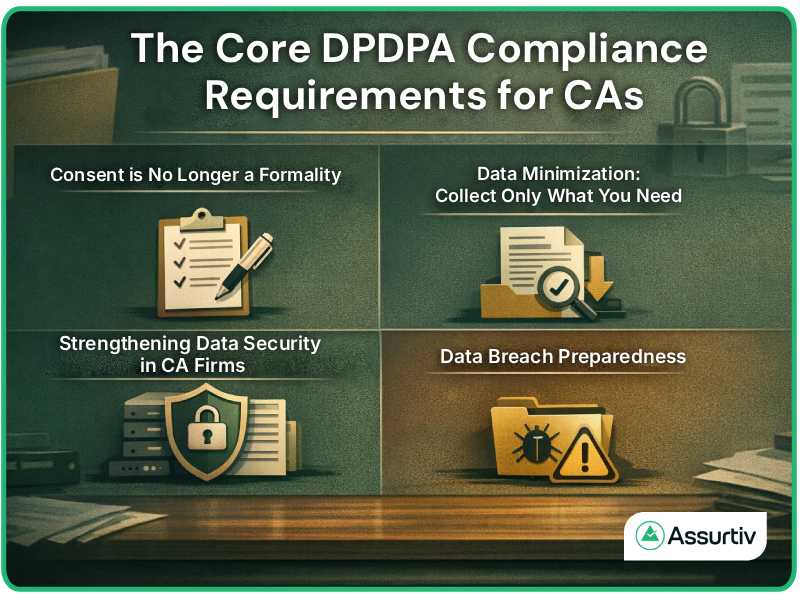
To effectively implement DPDPA compliance for Chartered Accountants, it is important to understand that the law is principle-based. It does not prescribe rigid processes but expects firms to adopt responsible data practices.
Consent is No Longer a Formality
One of the most significant changes introduced by DPDPA is the emphasis on clear and informed consent. For CA firms, this means moving away from implicit or assumed permissions.
Clients must be clearly informed:
- What data is being collected
- Why it is being collected
- How it will be used
For example, when a CA collects financial documents for tax filing, the purpose is clear. But if the same data is later used for advisory services or shared with third-party tools, explicit consent becomes critical.
In practice, this requires CA firms to:
- Introduce structured consent mechanisms
- Maintain records of consent
- Allow clients to withdraw consent easily
This is especially important in digital engagements where data flows across multiple systems.
Data Minimization: Collect Only What You Need
A common issue in CA practices is over-collection of data. Documents are often stored “just in case,” without a defined purpose. Under DPDPA, this approach is risky.
The principle is simple:
If you don’t need it, don’t collect it. If you don’t use it, don’t store it.
For instance, if a service only requires basic identification, storing additional personal details like family information or unrelated financial data can lead to compliance issues.
By limiting data collection:
- Risk exposure is reduced
- Data management becomes easier
- Compliance becomes more straightforward
Strengthening Data Security in CA Firms
Data security is at the heart of DPDPA compliance requirements for CAs. Given the sensitivity of financial data, even minor lapses can have serious consequences.
Many CA firms still rely on:
- Email-based document sharing
- Local storage systems
- Basic password protection
While these methods may seem convenient, they are often insufficient under DPDPA expectations.
Instead, firms should move towards:
- Encrypted storage systems
- Role-based access controls
- Secure client portals for document exchange
Think of data security not as a one-time setup, but as an ongoing process. Regular system updates, vulnerability checks, and access reviews are essential to ensure that data remains protected at all times.
Data Breach Preparedness
One of the most overlooked aspects of compliance is data breach readiness. Many firms assume breaches won’t happen to them—but DPDPA takes a different stance.
The law expects organizations to be prepared for incidents and respond quickly.
For Chartered Accountants, this means:
- Having a clear incident response plan
- Identifying what qualifies as a breach
- Knowing how and when to report it
If a breach occurs- say, a client’s financial file is accidentally shared with the wrong recipient- the firm may need to notify both the authorities and the affected individual.
Being prepared doesn’t just reduce penalties, it demonstrates professionalism and accountability.
Managing Data Across Tools, Teams, and Third Parties
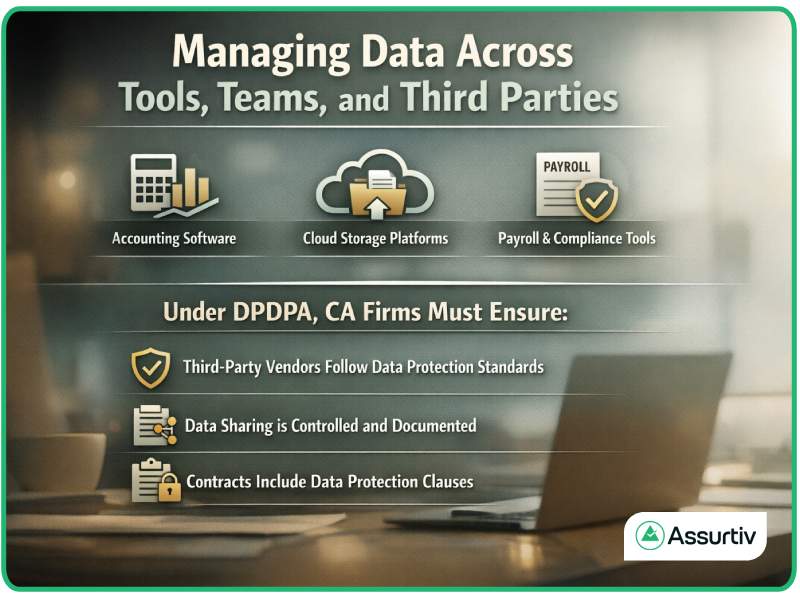
Modern CA firms rarely operate in isolation. They rely on:
- Accounting software
- Cloud storage platforms
- Payroll and compliance tools
Each of these systems processes personal data, which means compliance responsibility extends beyond internal operations.
Under DPDPA, CA firms must ensure that:
- Third-party vendors follow data protection standards
- Data sharing is controlled and documented
- Contracts include data protection clauses
This is particularly important when using SaaS platforms or outsourcing services. Even if a third party mishandles data, the primary responsibility still lies with the CA firm as the Data Fiduciary.
Data Retention: How Long is Too Long?
Another area where many CA firms struggle is data retention. Financial records are often stored indefinitely, either for convenience or due to uncertainty about legal requirements.
DPDPA introduces a clear expectation:
Personal data should not be retained longer than necessary.
This does not mean deleting everything immediately. Instead, firms should:
- Define retention timelines based on legal and business needs
- Periodically review stored data
- Securely delete or anonymize data when no longer required
For example, audit records may need to be retained for regulatory purposes, but once that obligation is fulfilled, continued storage must be justified.
Challenges in Achieving DPDPA Compliance for CA Firms
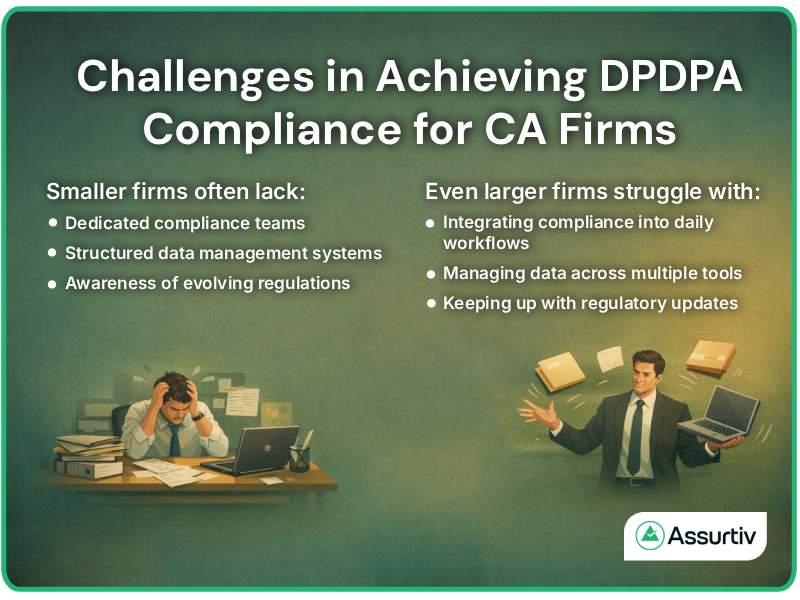
Despite understanding the requirements, many CA firms face practical challenges in implementation.
Smaller firms often lack:
- Dedicated compliance teams
- Structured data management systems
- Awareness of evolving regulations
Even larger firms struggle with:
- Integrating compliance into daily workflows
- Managing data across multiple tools
- Keeping up with regulatory updates
This is where a structured approach becomes essential.
How Chartered Accountants Can Simplify DPDPA Compliance
Achieving compliance does not have to be overwhelming. With the right strategy, CA firms can integrate data protection into their existing processes.
A few practical steps include:
- Digitizing document management systems
- Standardizing client onboarding with consent workflows
- Training staff on data handling practices
- Conducting periodic internal audits
Many firms are also adopting DPDP compliance software or GRC tools to automate tasks such as consent tracking, risk assessment, and audit readiness.
The goal is not just compliance—but efficient, scalable compliance.
Penalties and Risks of Non-Compliance
Ignoring DPDPA compliance requirements for Chartered Accountants can lead to serious consequences.
The Act allows penalties of up to ₹250 crore depending on the nature of the violation. However, financial penalties are only part of the risk.
More critical impacts include:
- Loss of client trust
- Reputational damage
- Increased scrutiny from regulators
In a profession built on credibility, even a single compliance failure can have long-term effects.
Conclusion
For Chartered Accountants, DPDPA compliance should not be seen as a burden. Instead, it is an opportunity to strengthen client relationships and differentiate in a competitive market.
Firms that proactively adopt data protection practices will:
- Build stronger client trust
- Reduce operational risks
- Stay ahead of regulatory changes
In the coming years, clients will increasingly prefer professionals who can guarantee not just financial accuracy—but also data security.
Frequently Asked Questions (FAQs)
Are Chartered Accountants required to comply with DPDPA?
Yes, any CA or CA firm handling personal data must comply with DPDPA as they act as Data Fiduciaries.
What kind of data is covered under DPDPA for CAs?
Personal data such as PAN, Aadhaar, financial records, contact details, and payroll information.
Is client consent mandatory for all services?
Yes, CAs must obtain clear and informed consent before collecting and processing personal data.
Do small CA firms also need to comply?
Absolutely. DPDPA applies irrespective of the size of the firm.
What should a CA firm do in case of a data breach?
They must report the breach to authorities and inform affected clients as per DPDPA rules.
How can CA firms manage compliance efficiently?
By adopting secure systems, training staff, and using compliance or GRC tools.