

Data Principal Rights Under DPDP Act: What Businesses Must Know in 2026
Dhiren M | 1 Apr 2026 | 9 Apr 2026
As organizations move from understanding the DPDP Act to implementing it, one area is becoming increasingly critical- Data Principal Rights of DPDP.
The Digital Personal Data Protection Act is not just about protecting digital personal data. It fundamentally shifts control toward individuals, requiring organizations to actively enable, manage, and respond to user rights.
For businesses, this means compliance is no longer limited to internal policies—it now depends on how effectively you handle real user requests, ensure transparency, and maintain accountability.
This guide explains the data principal rights under DPDP Act in detail and how organizations can operationalize them efficiently.
Why Data Principal Rights Are Central to DPDP Compliance
Traditionally, data protection frameworks focus on how organizations manage data processing internally. However, the DPDP Act introduces a more user-centric approach, where individuals are given direct control over their personal data.
This creates a shift in compliance expectations:
- From internal controls → to user-facing accountability
- From policy documentation → to real-time execution
- From static compliance → to continuous responsiveness
For decision-makers, this means that the ability to handle data principal requests efficiently is now a key indicator of compliance maturity.
Who is a Data Principal?
Under the DPDP Act, a data principal is any individual whose digital personal data is being processed.
This includes:
- Customers interacting with your platform
- Employees whose data is stored internally
- Users of websites or applications
- Vendors or partners whose personal data is processed
In simple terms, if your organization processes any form of personal data, you are responsible for enabling the rights of those individuals.
Overview of Data Principal Rights Under DPDP Act
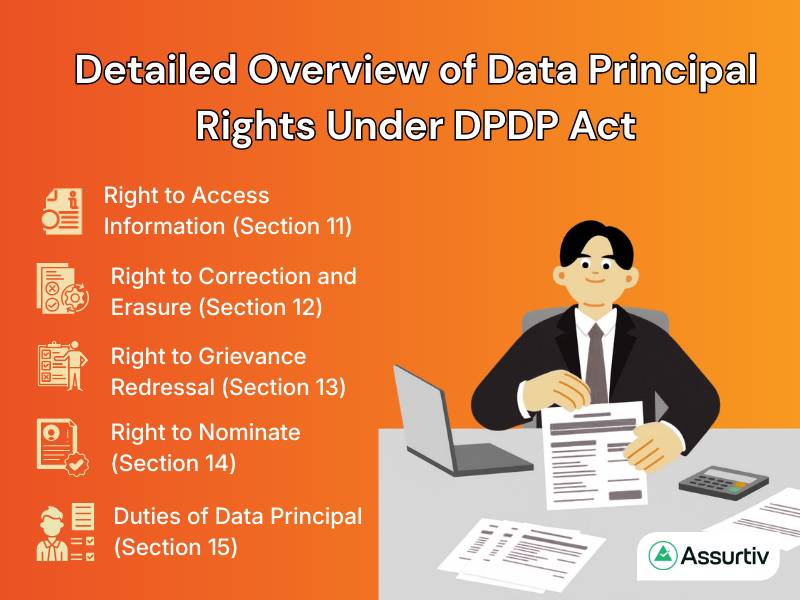
Data Principal rights under the DPDP Act 2023 are primarily covered under Chapter 3 (Sections 11–15), which includes rights to access, correction, erasure, and grievance redressal. These rights are further detailed in Rule 14 of the Digital Personal Data Protection Rules, 2025.
Right to Access Information (Section 11)
One of the most fundamental rights under the DPDP Act is the ability of individuals to understand how their data is being used.
A data principal can request information such as:
- What personal data is being collected
- Why the data is being processed
- How long the data is retained
- Whether the data is shared with third parties
Why this matters for businesses
Organizations must ensure that their systems can provide clear, accurate, and structured responses. This requires strong data visibility and documentation of data processing activities.
In many cases, businesses struggle not because they refuse access—but because they cannot locate all relevant data quickly enough.
Right to Correction and Erasure (Section 12)
Data principals have the right to ensure that their personal data remains accurate and relevant.
They can request:
- Correction of incorrect or outdated data
- Completion of incomplete data
- Deletion (erasure) of data that is no longer necessary
Practical implications
This right introduces operational complexity. In most organizations, digital personal data is spread across multiple systems, including CRM platforms, HR tools, and cloud applications.
To fulfill this right, businesses must:
- Identify all locations where the data exists
- Ensure updates are reflected across systems
- Maintain consistency after changes
Without proper data mapping, fulfilling these requests becomes slow and error prone.
Right to Grievance Redressal (Section 13)
The DPDP Act requires organizations to provide a mechanism for individuals to raise concerns regarding their personal data.
These grievances may relate to:
- Unauthorized data processing
- Delayed responses to requests
- Incorrect handling of personal data
What organizations must implement
- A formal grievance handling system
- Defined response timelines
- Clear communication channels
More importantly, organizations must maintain records of complaints and their resolutions, as these may be reviewed during regulatory inspections.
4. Right to Nominate (Section 14)
A unique aspect of the DPDP Act is the right of individuals to nominate another person to exercise their rights in case of death or incapacity.
Business implications
Organizations must:
- Provide mechanisms for nomination
- Verify nominee identity before processing requests
- Maintain secure records of nominations
This requirement adds another layer of complexity, especially for organizations managing large user bases.
Duties of Data Principal (Section 15)
Section 15 outlines specific duties that Data Principals must abide by, as detailed on indiadpdpa.com:
- Legal Compliance: Must comply with all applicable laws while exercising their rights.
- No Impersonation: Must not impersonate another person while providing personal data.
- No Material Suppression: Must not suppress material information when providing data for identity proof (e.g., Aadhar, PAN).
- No False/Frivolous Grievances: Must not register false, frivolous, or vexatious grievances or complaints.
- Authentic Information: Must ensure provided information is verifiably authentic when exercising correction or erasure rights.
Operational Challenges in Managing Data Principal Rights
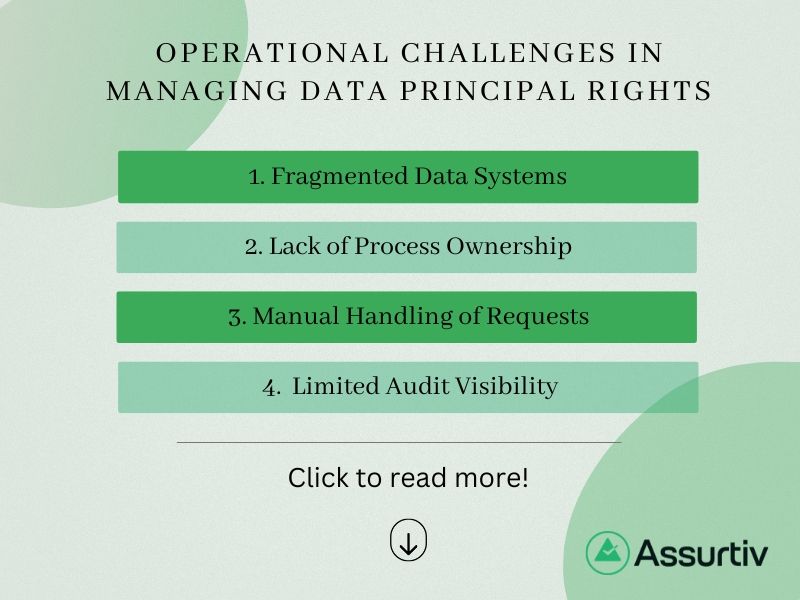
While the rights themselves are clearly defined, implementation remains a major challenge.
Common issues organizations face:
- Fragmented Data Systems
Personal data is distributed across multiple platforms, making retrieval difficult. - Lack of Process Ownership
No single team is responsible for handling user rights end-to-end. - Manual Handling of Requests
Email-based or spreadsheet-driven processes lead to delays and errors. - Limited Audit Visibility
Organizations cannot prove how requests were handled.
These challenges highlight the need for a structured and system-driven approach.
How Businesses Can Effectively Manage Data Principal Rights
Build Centralized Data Visibility
Organizations must create a unified view of digital personal data across systems. This enables faster response to user requests and reduces operational complexity.
Automate Request Handling Workflows
Instead of manual processes, businesses should implement systems that:
- Track incoming requests
- Assign ownership
- Monitor response timelines
- Maintain audit logs
Automation significantly improves efficiency and compliance accuracy.
Integrate Consent with Processing Systems
Consent should not exist as a standalone record. It must directly influence how data is processed across systems.
This ensures that when consent is withdrawn, all related processing activities are automatically stopped.
Enable Cross-Functional Collaboration
Handling data principal rights DPDP requires coordination between:
- Legal teams
- IT departments
- Security teams
- Customer support
Organizations must establish clear ownership and communication channels.
Maintain Audit-Ready Documentation
At any point, organizations should be able to demonstrate:
- When a request was received
- How it was processed
- When it was completed
This level of traceability is critical for regulatory compliance.
Role of GRC Platforms in Managing Data Principal Rights
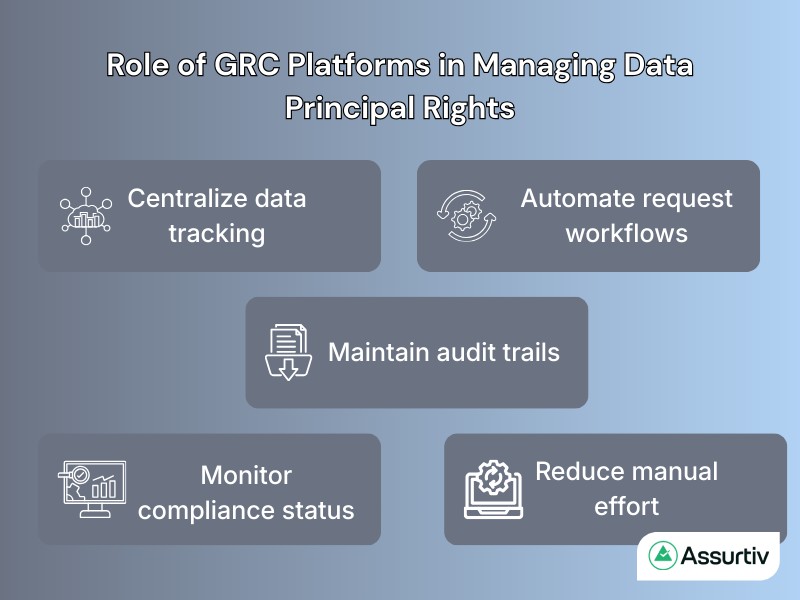
Given the complexity involved, many organizations are adopting GRC and privacy management platforms.
These platforms help:
- Centralize data tracking
- Automate request workflows
- Maintain audit trails
- Monitor compliance status
- Reduce manual effort
This enables organizations to move from reactive handling → proactive rights management.
Best Practices for DPDP Data Principal Rights Compliance
Organizations that perform well in this area typically:
- Design systems with privacy-first architecture
- Maintain real-time visibility of personal data
- Automate user request handling
- Regularly audit rights management processes
- Train teams on data protection responsibilities
Conclusion
The data principal rights under DPDP are not just regulatory requirements— they represent a fundamental shift toward user-controlled data governance.
Organizations that can effectively:
- Respond to user requests
- Maintain transparency
- Demonstrate accountability
will stand out as trusted and compliant entities in the digital ecosystem.
As enforcement becomes stricter, the question is no longer:
“Do we understand DPDP?”
But rather:
“Can we consistently deliver on data principal rights?”
Frequently Asked Questions (FAQs)
What are data principal rights under DPDP?
Data principal rights under DPDP include access to personal data, correction, erasure, consent withdrawal, grievance redressal, and nomination rights.
Why are data principal rights important for businesses?
They are critical because they directly impact how organizations handle user data and demonstrate compliance with the DPDP Act.
What is the biggest challenge in managing these rights?
The biggest challenge is operational execution, especially due to fragmented data systems and manual processes.
How can organizations improve their response to user requests?
By implementing centralized data systems, automating workflows, and integrating consent management with data processing systems.
Do companies need technology solutions for managing DPDP rights?
While not mandatory, most organizations adopt GRC or privacy platforms to ensure efficiency, scalability, and audit readiness.