

Privacy Law Penalties in Different Countries
Dhiren M | 20 Mar 2026 | 26 Mar 2026
Data protection enforcement has entered a new era. Across jurisdictions, regulators are no longer issuing symbolic fines; they are imposing penalties tied to global turnover, operational revenue, and systemic governance failures.
For compliance leaders, understanding privacy law penalties in different countries is not about regulatory awareness—it is about enterprise risk exposure.
Based on the latest comparative regulatory data (2026), privacy laws now carry:
- Up to €20 million or 4% of global turnover under GDPR (EU)
- Up to ₹250 crore per significant contravention under India’s DPDP Act
- Up to 10% of annual turnover in Singapore under PDPA
- Up to $7,988 per intentional violation under California’s CPRA
- Up to 2% of Brazilian revenue (capped at 50 million BRL) under LGPD
The global message is consistent: privacy compliance failures now carry financial consequences.
Why Privacy Law Penalties in Different Countries Matter to Management
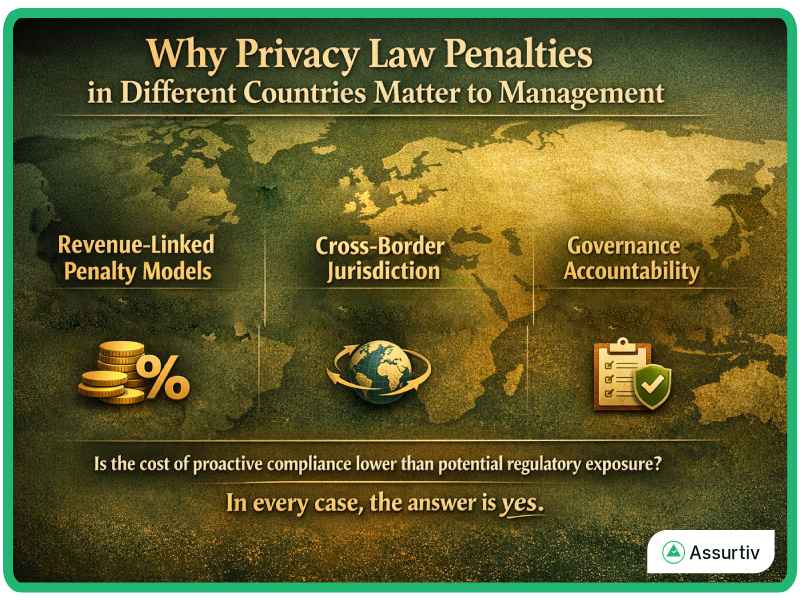
Three structural shifts make privacy laws penalties a board-level priority:
- Revenue-Linked Penalty Models
Modern privacy laws tie fines to annual turnover, dramatically increasing financial impact.
- Cross-Border Jurisdiction
Even without physical presence, organizations can be fined if they process residents’ data.
- Governance Accountability
Regulators now assess whether boards exercised oversight—not just whether a breach occurred.
Is the cost of proactive compliance lower than potential regulatory exposure?
In every case, the answer is yes.
Major Privacy Laws and Their Penalty Frameworks
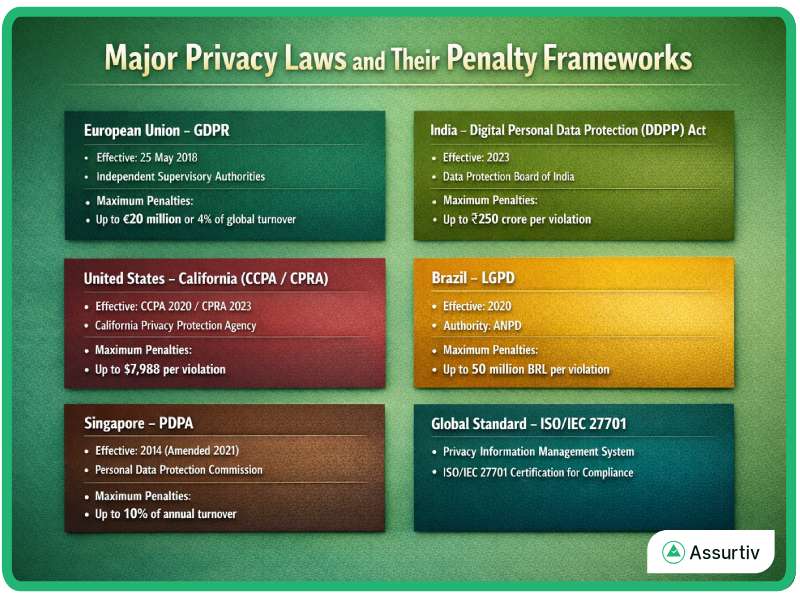
Below is a structured breakdown country wise:
European Union – GDPR
Effective: 25 May 2018
Supervisory Authority: Independent Supervisory Authorities coordinated by EDPB
Scope: Controllers and processors handling EU personal data
Maximum Penalties:
- Up to €10 million or 2% of global annual turnover (lower tier)
- Up to €20 million or 4% of global annual turnover (higher tier)
GDPR penalties typically arise from:
- Failure to implement appropriate security safeguards
- Violation of data subject rights
- Unlawful cross-border transfers
- Breach notification delays (must report within 72 hours)
Because fines are tied to global revenue, multinational enterprises face significant exposure.
India – Digital Personal Data Protection (DPDP) Act
Effective: 2023 (Rules notified 2025; enforcement phased)
Authority: Data Protection Board of India
Maximum Penalties:
Specific contraventions include:
- Security safeguard failures
- Breach notification violations
- Governance failures for Significant Data Fiduciaries
The DPDP Act reinforces that risk mitigation strategies must integrate data governance, cybersecurity, and board oversight.
United States – California (CCPA / CPRA)
Effective: CCPA (2020), CPRA amendments operative 2023
Authority: California Privacy Protection Agency
Maximum Penalties:
- Up to $2,663 per violation
- Up to $7,988 per intentional violation
Unlike turnover-based models, U.S. enforcement is calculated per violation. At scale, especially for consumer platforms, aggregated penalties can escalate rapidly.
The removal of the 30-day cure period under CPRA has further increased enforcement risk.
Brazil – LGPD
Effective: 2020 (sanctions from August 2021)
Authority: ANPD
Maximum Penalties:
- Up to 2% of Brazilian revenue, capped at 50 million BRL per violation
Brazil’s LGPD aligns closely with GDPR in principles, including lawful basis, data subject rights, and cross-border safeguards.
Singapore – PDPA
Effective: 2014 (major amendments 2021)
Authority: Personal Data Protection Commission (PDPC)
Maximum Penalties:
- Up to 10% of annual turnover in Singapore
This revenue-based model represents a major escalation compared to earlier fixed fine structures.
Mandatory breach of notification and DPO appointment further increase governance obligations.
Global Standard – ISO/IEC 27701
While not a statutory law, ISO/IEC 27701 (Privacy Information Management System) serves as a globally recognized framework supporting compliance with GDPR, DPDP, and other regulations.
There are no direct fines, but certification strengthens compliance with defensibility.
Comparative Overview of Privacy Law Penalties in Different Country
| Country | Law | Maximum Penalty Structure |
| EU | GDPR | €20M or 4% global turnover |
| India | DPDP Act | ₹250 Cr |
| U.S. (California) | CPRA | $7,500 per intentional violation |
| Brazil | LGPD | 2% of revenue (capped) |
| Singapore | PDPA | 10% of local turnover |
For multinational enterprises, cumulative regulatory exposure requires harmonized compliance controls.
Key Factors That Increase or Reduce Privacy Law Penalties
Factors that increase severity of Penalty:
- Intentional misconduct
- Large-scale or sensitive data exposure
- Repeat violations
- Poor cooperation with regulators
- Lack of security measures
- Delayed or failed breach notification
Exemptions / Reduced penalties
- Prompt mitigation and cooperation
- Low-risk or minor violations
- Acceptance of voluntary undertakings (e.g., Singapore PDPA)
- Legal carve-outs (e.g., academic research under LGPD)
- Discretionary cure opportunities (e.g., CPRA)
What This Means for Enterprise Risk Management
Understanding privacy laws penalties for different countries is not about memorizing numbers. It is about assessing:
- Multi-jurisdictional exposure
- Vendor and third-party risk
- Cross-border transfer compliance
- Breach response maturity
- Board reporting structures
Privacy risk must now sit alongside financial reporting risk and cybersecurity risk within enterprise risk management dashboards.
Strategic Risk Mitigation Across Jurisdictions
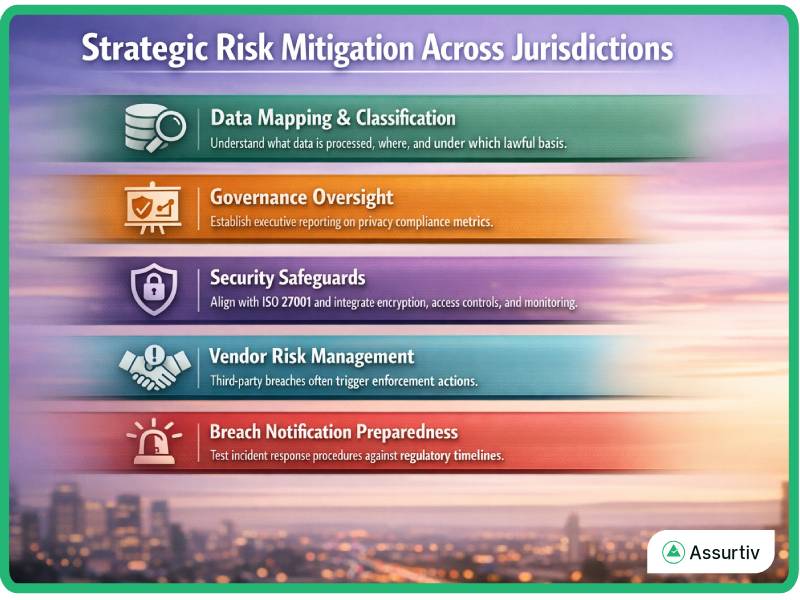 Decision-makers should prioritize:
- Data Mapping & Classification: Understand what data is processed, where, and under which lawful basis.
- Governance Oversight: Establish executive reporting on privacy compliance metrics.
- Security Safeguards: Align with ISO 27001 and integrate encryption, access controls, and monitoring.
- Vendor Risk Management: Third-party breaches often trigger enforcement actions.
- Breach Notification Preparedness: Test incident response procedures against regulatory timelines.
The objective is not just compliance—but defensibility.
Conclusion
The comparative analysis of privacy law penalties in different countries clearly demonstrates a global escalation in enforcement intensity.
Revenue-linked fines, per-violation penalties, and governance accountability models signal that privacy compliance is now a financial and strategic priority.
For decision-makers, the choice is straightforward:
Invest proactively in compliance infrastructure
Or risk reactive regulatory exposure
Organizations that harmonize compliance across jurisdictions, embed privacy into enterprise risk management, and strengthen governance oversight will reduce enforcement exposure and enhance stakeholder trust.
In today’s regulatory climate, privacy resilience is a competitive advantage.
FAQs on Privacy Law Penalties
Which country imposes the highest privacy penalties?
The EU under GDPR can impose up to 4% of global annual turnover, making it the most financially impactful framework globally.
Can a company be penalized in multiple jurisdictions for the same breach?
Yes. Cross-border enforcement cooperation allows regulators in different countries to impose penalties.
Are penalties calculated per incident or per violation?
It depends on the jurisdiction.
(For example, California calculates penalties per violation, while GDPR ties fines to turnover).
Does ISO 27701 protect against penalties?
While not a legal shield, ISO 27701 strengthens compliance defensibility and demonstrates governance maturity.
How should boards respond to global privacy enforcement?
Boards should integrate privacy risk into enterprise risk management, mandate regular compliance reporting, and ensure cross-jurisdictional oversight.