
DPDPA Compliance Checklist for Indian Businesses
Chakrapani KVC | 27 Mar 2026 | Not Modified
With the DPDP Act now moving into active implementation, organizations are no longer asking “What is DPDP?”—they are asking:
“Are we actually compliant?”
For compliance leaders, CISOs, and risk teams, the challenge is not understanding the regulation, but operationalizing it across systems, teams, and vendors.
This DPDPA Compliance Checklist shall abide the DPDP Act, 2023 & DPDP Rules enforced in Nov 2025 and is designed as a practical execution framework, helping Indian businesses move from policy-level understanding to real-world compliance readiness—without repeating legal theory.
DPDP Act Compliance Is No Longer Theoretical — It is Operational
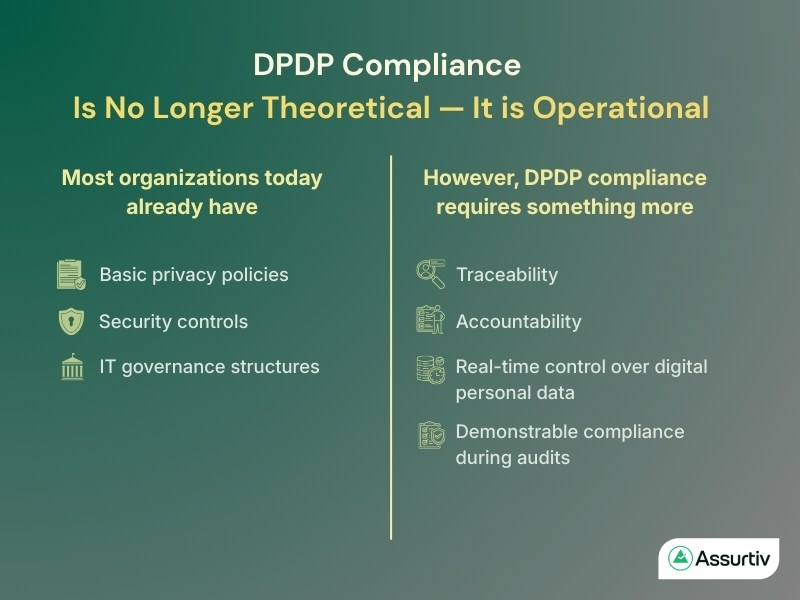
Most organizations today already have:
- Basic privacy policies
- Security controls
- IT governance structures
However, DPDP compliance requires something more:
- Traceability
- Accountability
- Real-time control over digital personal data
- Demonstrable compliance during audits
This checklist focuses on what regulators expect you to prove—not just what you say you do.
DPDPA Compliance Checklist (Execution-Focused)
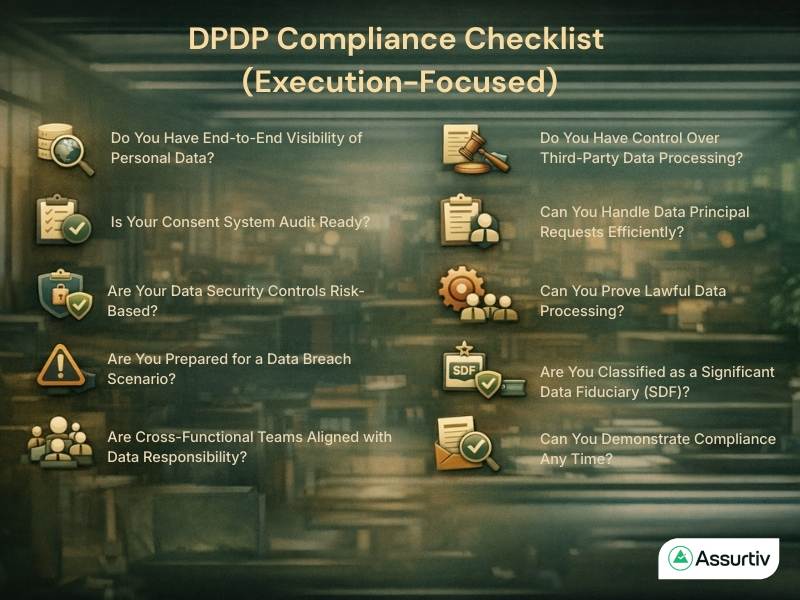
1. Do You Have End-to-End Visibility of Personal Data?
Many organizations underestimate how fragmented their data processing environments are.
What to verify:
- Do you know where all personal data resides (apps, cloud, SaaS, emails)?
- Is your data inventory continuously updated, not static?
- Can you identify which business function owns which data?
Compliance gap: Most failures occur due to incomplete data visibility.
2. Can You Prove Lawful Data Processing?
It is not enough to define purpose—you must demonstrate it clearly.
What to verify:
- Is every data collection point linked to a defined purpose?
- Can you show evidence of lawful processing?
- Are “default data collection practices” eliminated?
Focus shifts from policy → proof.
3. Is Your Consent System Audit Ready?
Consent is one of the most scrutinized areas under the DPDP Act.
What to verify:
- Are consent notices clear, specific, and understandable?
- Can users easily withdraw consent?
- Do you maintain timestamped consent records?
Key risk: Many systems capture consent—but cannot prove it during audits.
4. Can You Handle Data Principal Requests Efficiently?
Handling rights is not just a legal requirement—it is an operational capability.
What to verify:
- Do you have a system to track access, correction, and erasure requests?
- Are response timelines defined and monitored?
- Can you locate user data quickly across systems?
Organizations struggle due to disconnected systems.
5. Are Your Data Security Controls Risk-Based?
Generic security is no longer sufficient.
What to verify:
- Are controls aligned to data sensitivity levels?
- Do you monitor unauthorized access in real-time?
- Are privileged access controls enforced?
Regulators expect risk-based data protection—not one-size-fits-all security.
6. Do You Have Control Over Third-Party Data Processing?
Your vendors can become your biggest compliance risk.
What to verify:
- Do you know which vendors process personal data?
- Are DPDP obligations included in vendor contracts?
- Do you perform ongoing vendor risk assessments?
Reality: Most breaches originate from third-party ecosystems.
7. Are You Prepared for a Data Breach Scenario?
Preparedness matters more than prevention alone.
What to verify:
- Do you have a documented incident response plan?
- Can your team detect breaches in real time?
- Are escalation workflows clearly defined?
Delay in response = higher regulatory exposure.
8. Are You Classified as a Significant Data Fiduciary (SDF)?
If yes, your compliance expectations are significantly higher.
Additional checks:
- Have you appointed a Data Protection Officer (DPO)?
- Are Data Protection Impact Assessments (DPIAs) conducted?
- Do you maintain independent audit mechanisms?
SDFs must demonstrate higher governance maturity.
9. Are Cross-Functional Teams Aligned with Data Responsibility?
DPDP compliance is not just a legal or IT function.
What to verify:
- Are business teams aware of data handling responsibilities?
- Is there clear ownership across:
- IT
- Legal
- Compliance
- Operations
- Are decisions involving personal data centrally governed?
Lack of alignment leads to uncontrolled data processing.
10. Can You Demonstrate Compliance Any Time?
This is the most critical question.
What to verify:
- Do you maintain compliance with documentation and evidence?
- Are internal audits conducted regularly?
- Can you produce compliance reports instantly if required?
DPDP is moving towards a “show me” compliance model.
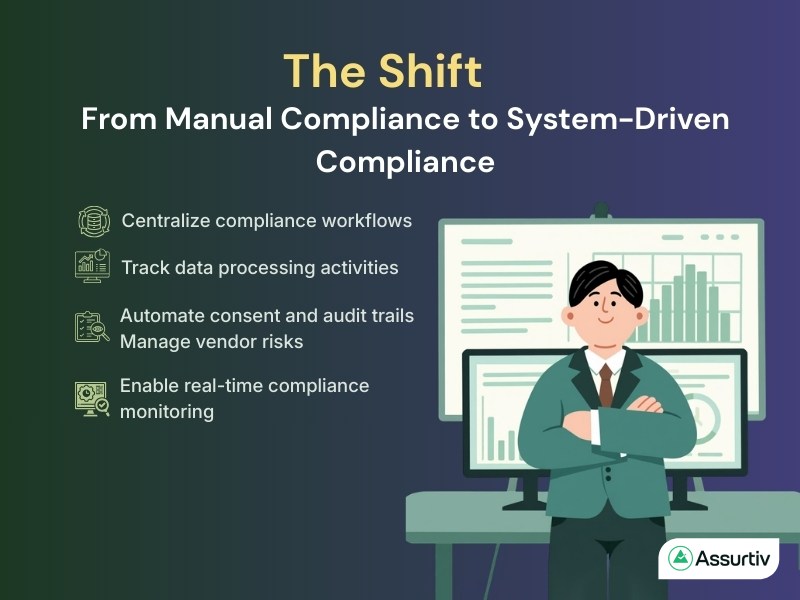
The Shift: From Manual Compliance to System-Driven Compliance
Manual tracking using spreadsheets or siloed systems is no longer sustainable.
Organizations are increasingly adopting GRC (Governance, Risk, and Compliance) platforms to:
- Centralize compliance workflows
- Track data processing activities
- Automate consent and audit trails
- Manage vendor risks
- Enable real-time compliance monitoring
This transition helps organizations move from:
Reactive compliance → Proactive compliance management
Common DPDP Compliance Gaps Businesses Must Avoid
Even mature organizations face these issues:
- Treating compliance as a one-time project
- Lack of data visibility across systems
- Weak consent tracking mechanisms
- No integration between legal, IT, and operations
- Ignoring vendor risk exposure
Addressing these gaps early can significantly reduce regulatory and operational risk. Also, you can check our DPDPA Implementation Roadmap video that recently was part of our webinar sessions.
Conclusion
The DPDPA Compliance Checklist is not just a regulatory requirement—it is a business-critical framework for managing digital trust.
Organizations that succeed in DPDP compliance will be those that:
- Operationalize data protection
- Build system-driven governance
- Maintain continuous compliance visibility
- Align teams, processes, and technology
Instead of asking “Are we compliant?” leading organizations are now asking:
“Can we prove compliance at any time?”
That shift defines true readiness under the DPDP Act.
Frequently Asked Questions (FAQs)
What makes a DPDP compliance checklist different from a general privacy checklist?
A DPDP Compliance Checklist focuses on India-specific regulatory requirements, including consent management, data fiduciary responsibilities, and accountability under the DPDP Act.
How often should organizations review their DPDP compliance status?
Organizations should review compliance continuously, with periodic audits (quarterly or bi-annually) and real-time monitoring for critical controls.
Is DPDP compliance only relevant for large enterprises?
No. Any organization processing digital personal data in India, regardless of size, must ensure compliance with the DPDP Act.
What is the biggest challenge in DPDP compliance?
The biggest challenge is operationalizing compliance, ensuring that policies translate into real, trackable actions across systems and teams.
Do companies need software tools for DPDP compliance?
While not mandatory, many organizations use GRC or privacy management platforms to automate compliance, reduce risks, and improve audit readiness.