
Integrated GRC Maturity Level: 5 Stages to Achieve Integrated Risk & Compliance
assurtiv | 23 Dec 2024 | 24 Mar 2026
In today’s regulatory landscape, organizations can no longer afford fragmented approaches to governance, risk, and compliance. Disconnected systems, manual processes, and siloed decision-making not only increase operational inefficiencies but also expose businesses to regulatory and reputational risks.
This is where understanding your Integrated GRC maturity level becomes essential. It provides a clear view of how effectively your organization aligns risk management and compliance with broader business objectives and how prepared you are to scale securely.
This article explores the five stages of Integrated GRC maturity level, the challenges organizations face, and how to systematically advance toward a more integrated and value-driven GRC environment.
What is Integrated GRC Maturity Level?
The Integrated GRC maturity level reflects the degree to which an organization has embedded governance, risk, and compliance into its core operations through a unified and structured approach.
Rather than treating GRC as isolated functions, mature organizations integrate these elements across business units, enabling consistent decision-making and real-time risk visibility. At lower maturity levels, GRC tends to be reactive and compliance-driven. As maturity increases, it evolves into a proactive, strategic capability that supports business growth.
Ultimately, maturity is not just about process efficiency—it is about how well risk intelligence informs business strategy.
Why Integrated GRC Maturity Level Matters
Organizations operating at lower maturity levels often struggle with inconsistent reporting, duplicated efforts, and limited visibility into enterprise-wide risks. These inefficiencies can lead to delayed responses, audit challenges, and increased regulatory exposure.
As the Integrated GRC maturity level improves, organizations begin to experience tangible benefits. Decision-making becomes more informed due to centralized risk insights. Compliance efforts become more streamlined, reducing operational overhead. Most importantly, GRC shifts from being a reactive obligation to a proactive driver of business resilience and trust.
In highly mature environments, GRC is not viewed as a control function alone—it becomes a strategic enabler that directly contributes to organizational performance.
The 5 Levels of Integrated GRC Maturity Model
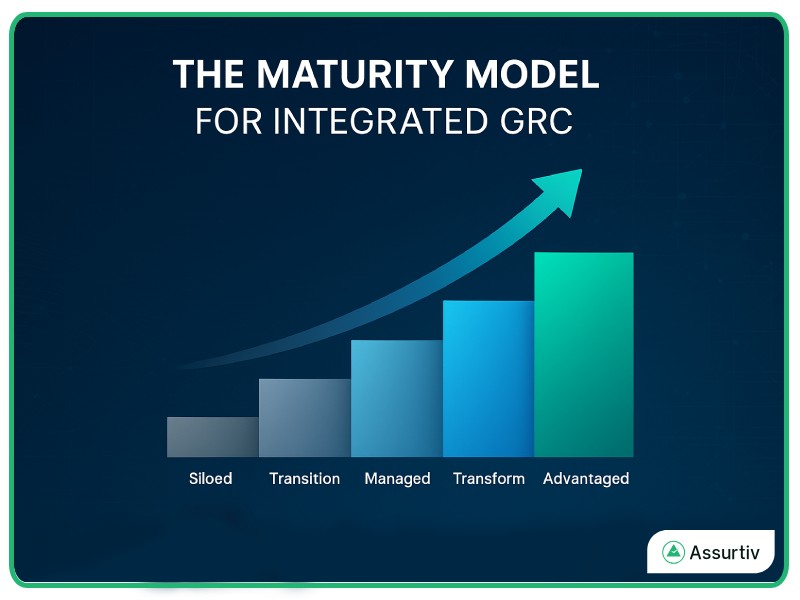
Siloed (Ad Hoc)
At the initial level, GRC activities are fragmented and largely reactive. Different departments operate independently, managing risks based on their immediate needs without a unified framework.
This lack of coordination results in inconsistent processes, duplicated efforts, and limited visibility into enterprise-wide risks. Organizations at this level often rely heavily on spreadsheets and manual tracking, making it difficult to respond effectively to evolving regulatory requirements.
Transition (Fragmented)
As organizations recognize the limitations of siloed operations, they begin moving toward a more coordinated approach. At this level, there is growing awareness of the need for integration, and initial steps are taken to standardize processes.
Collaboration between departments starts to improve, and management begins to support GRC initiatives more actively. However, despite these improvements, execution remains inconsistent, and technology systems are still not fully aligned.
Managed (Integrated)
At the managed level, organizations establish structured and repeatable GRC processes. Roles and responsibilities are clearly defined, and cross-functional collaboration becomes more systematic.
Standardized workflows and centralized reporting mechanisms enable better control and consistency. Many organizations at this level adopt integrated GRC platforms to streamline operations and improve coordination across risk, compliance, and audit functions.
This stage marks a significant shift from reactive management to controlled and predictable execution.
Transform (Data-Driven)
In the transformation stage, GRC becomes increasingly driven by data and insights. Organizations leverage advanced analytics and real-time monitoring to identify risks proactively and align them with business strategies.
Governance structures are strengthened, and reporting mechanisms provide leadership with actionable intelligence. Risk awareness extends across the organization, empowering teams to take ownership and make informed decisions.
At this level, GRC is no longer just about managing risk—it is about anticipating and mitigating it before it impacts the business.
Advantaged (Value-Focused)
At the highest Integrated GRC maturity level, GRC is fully embedded into the organization’s strategic framework. Processes are optimized, systems are integrated, and decision-making is driven by continuous insights.
Organizations at this stage foster a strong risk-aware culture where every function understands its role in governance and compliance. Risk prioritization is aligned with business objectives, enabling smarter investments and faster responses to emerging challenges.
GRC, in this context, becomes a competitive advantage—supporting agility, innovation, and long-term growth.
Challenges in Advancing Integrated GRC Maturity Level
Progressing through maturity levels is not without obstacles. One of the most common challenges is the lack of executive alignment. Without leadership support, GRC initiatives often lack the authority and resources required for effective implementation.
Another significant barrier is the persistence of siloed organizational structures. When departments operate independently, it becomes difficult to achieve a unified view of risk and compliance. Data fragmentation further complicates this issue, as inconsistent systems prevent accurate and timely reporting.
Resource constraints and resistance to change also play a critical role. Implementing integrated GRC requires investment in technology, process redesign, and cultural transformation—factors that organizations may initially resist.
Overcoming these challenges requires a clear strategy, strong governance, and a commitment to long-term improvement.
How Assurtiv Helps Improve Integrated GRC Maturity Level
Advancing your Integrated GRC maturity level requires more than incremental changes—it demands a cohesive approach that aligns people, processes, and technology.
Assurtiv enables this transformation by providing a centralized platform that unifies GRC activities across the organization. By eliminating data silos and standardizing workflows, it ensures consistency in risk and compliance management.
With real-time visibility into risk data and automated processes, organizations can move beyond manual efforts and make faster, more informed decisions. This not only improves operational efficiency but also strengthens audit readiness and regulatory compliance.
As a result, organizations using Assurtiv can accelerate their journey from fragmented GRC practices to a fully integrated and optimized maturity level.
Conclusion
Improving your Integrated GRC maturity level is a continuous journey that requires alignment, investment, and strategic focus. Each stage of maturity builds upon the previous one, enabling organizations to enhance their risk management capabilities and compliance effectiveness over time.
Organizations that successfully advance through these stages are better equipped to navigate regulatory complexities, respond to risks proactively, and align GRC with business objectives.
In a rapidly evolving risk landscape, achieving a higher maturity level is not just an operational goal—it is a strategic necessity for sustainable growth.
Frequently Asked Questions (FAQs)
What is an Integrated GRC maturity level?
The Integrated GRC maturity level measures how effectively an organization manages governance, risk, and compliance through a unified and structured approach.
What are the stages of GRC maturity level?
The five stages are: Siloed (Ad Hoc), Transition (Fragmented), Managed (Integrated), Transform (Data-Driven), and Advantaged (Value-Focused).
How can organizations assess their Integrated GRC maturity level?
By evaluating process integration, technology usage, data visibility, and alignment between risk management and business objectives.
Why is improving GRC maturity level important?
It reduces risk, improves compliance efficiency, enhances decision-making, and strengthens audit readiness.
What are the key challenges in improving maturity level?
Common challenges include siloed processes, lack of leadership support, fragmented data, and resistance to change.
How does Integrated GRC software help?
It centralizes data, automates workflows, standardizes processes, and provides real-time risk insights.
What is the difference between maturity model and maturity level?
The model defines the framework; the maturity level shows your current position.
How long does it take to improve maturity level?
Typically 6–18 months for initial improvement and up to 36 months for advanced maturity, depending on the organization.